Hungarian Desks: Assigning Office Seats with the Hungarian Algorithm
In nearly any company, but especially tech companies, how does one handle seating arrangements? Often this is done by department, but for smaller companies without so much space — and especially now with more flexible work-from-home and partial remote policies — a more fluid use of desk space is often preferable.
A while ago, I wrote a little tool to solve this in an interesting way, which I’ve put up on GitHub as schacon/hungarian-desks. Here’s the thinking behind it.
The Problem with Seating
At Chatterbug, and at GitHub before this, my companies have always had a pretty open seating policy where people could sit pretty much wherever they wanted in the office. Sometimes teams sat near each other, but often they were remote anyhow, so that wasn’t possible. In fact, with remote companies it’s often better to seat people who are in the office apart from each other, so that they communicate asynchronously as well.
In fact, mixed seating is arguably good for cross-company communication and serendipitous interactions. At GitHub we even had a day every few months where we would play Musical Desks, where everyone who wanted to would pick up and move somewhere new. This is easier if everyone does it at the same time, so there are desks opening up at the same time.
The Random Method
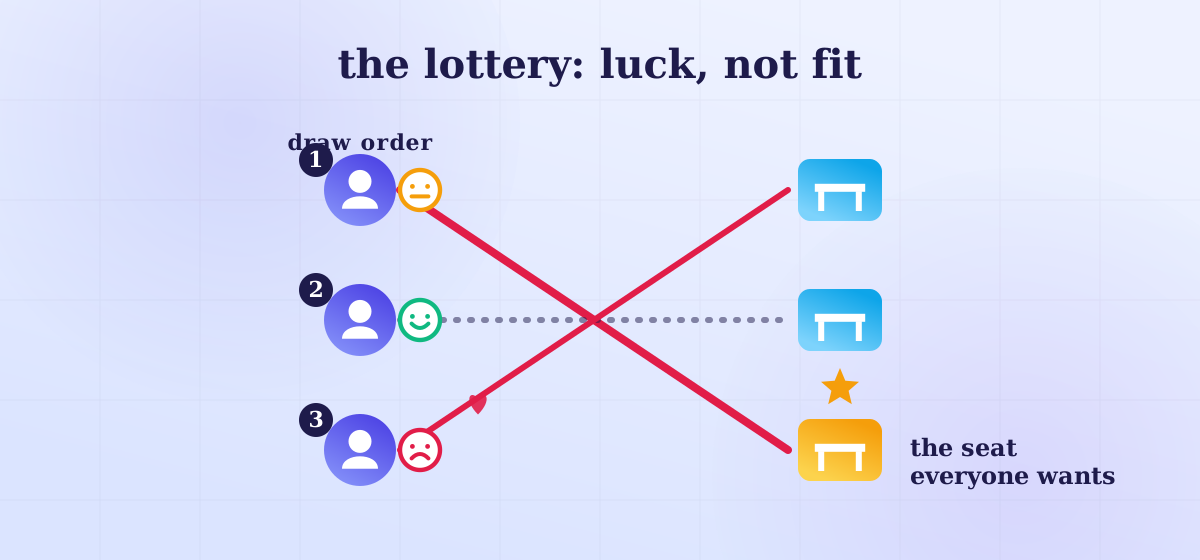
At Chatterbug when we moved into a new space, we needed to determine how to allot seats and the first version was a simple lottery. Each person’s name is drawn and they choose what seat they want in the order drawn.
This has the fairness of randomness to it, but it’s not actually ideal for optimizing the assignments. Someone could, for example, not care too much and choose a seat semi-randomly that someone else really wanted.
The Hungarian Method
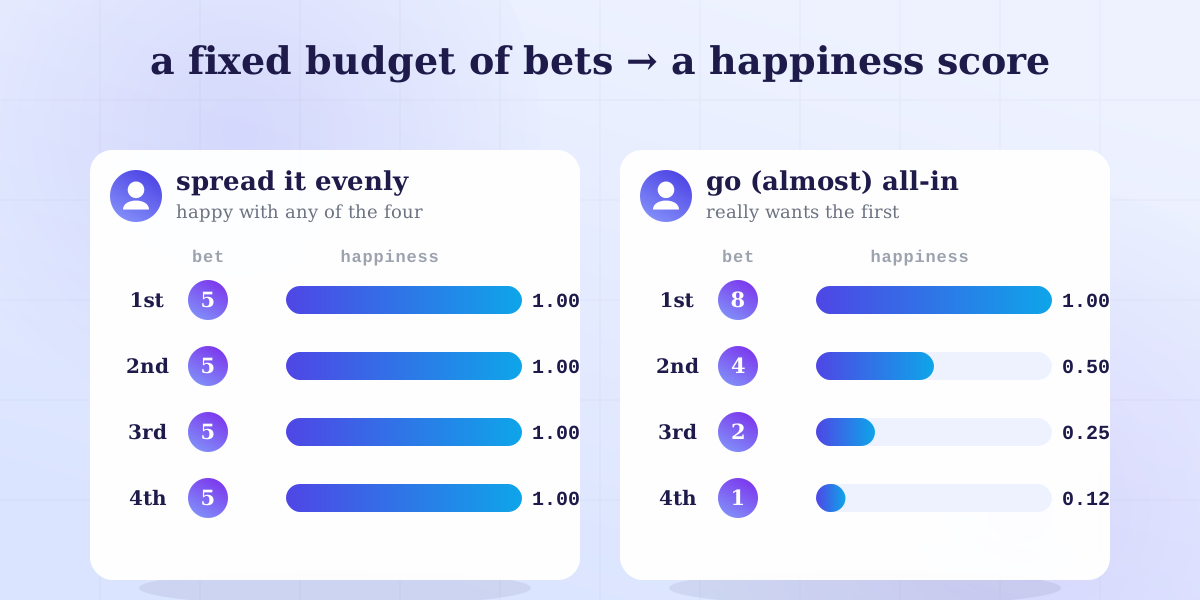
We tried to solve this issue with version 2 of the seat picker. In this version, we have people give us some information about a few top choices. Also, instead of just ranking them, we have them “bet” on the choices. This way if you don’t really care or want to sit in a specific area, you can put the same bet on all 4 choices. Or if you really care, you can put most of your bet on a single choice.
This allows us to determine a “happiness” with a set of seats. We assign each user/seat combination a value from 0.0 to 1.0, with zero being totally unhappy (ie, a random seat not in their list) and 1.0 being totally happy (ie, the choice they bet the most on). We weight the user’s choices to be internally relative, so if one user bets 8 on one seat and 4 on another, they would get scores of 1.0 and 0.5 for those seats, since one is half as valuable to the user as the top choice. If the user bets the same value on all 4 choices, each seat is assigned 1.0 since the user would be just as happy with any of them.
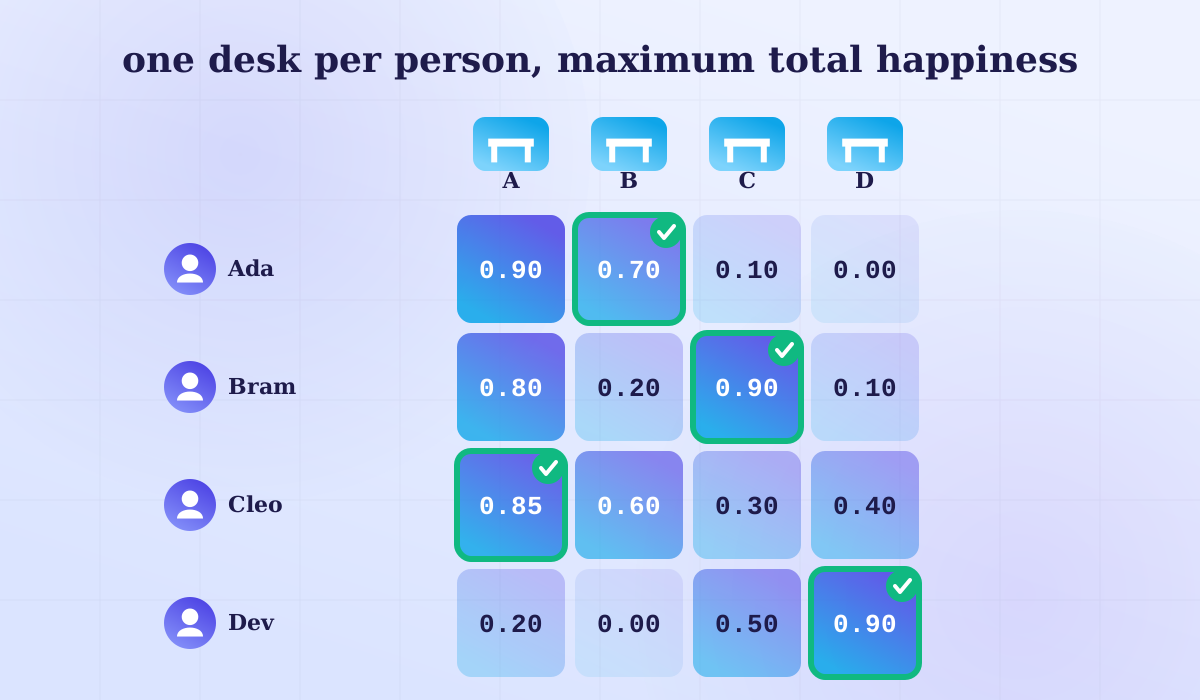
Now we essentially have the data to do a cost matrix that we can treat as a classical assignment problem, since the sets of seats and people are essentially a weighted bipartite graph. We can invert the values of the happiness score (so 0 is totally happy — no cost, and 1 is totally unhappy, the highest cost) and use that cost matrix as the input to an implementation of the Hungarian algorithm to come up with a set of assignments that optimizes for low cost, and thus, highest total assignment happiness.
The Data and Code
Now we just need everyone in the company to fill out a form telling us their top choices and bets, so we can calculate the optimal assignments.
We decided to try the easiest route, which is to have everyone fill out an Airtable form, which gives us a nice simple database of all the users and their choices that is easily API accessible. Then we wrote a script to pull those choices down, do the math, make the assignments and upload the assignments (as well as the calculated “happiness” score for each user).
The code is on GitHub at schacon/hungarian-desks if you’d like to try it or adapt it for your own office.